Play was never just about children
Walk through any well-used public park on a Saturday morning and you’ll notice something interesting.
The playground isn’t occupied solely by children. It’s filled with parents drinking coffee, grandparents watching from nearby benches, teenagers lingering at the edges, toddlers discovering textures for the first time, cyclists passing through and dog walkers stopping for conversation.
What was once considered a destination for children has quietly evolved into something much broader. The modern playground has become one of the few genuinely shared public spaces where different generations, backgrounds and abilities come together naturally.
A true community space.
Yet much of our industry continues to approach playgrounds as though none of this has changed.
For decades, the process has often been remarkably similar. A space is allocated for play, a budget is established, the relevant safety standards are met and catalogue equipment is selected to maximise play value within the available area. In many cases it becomes an exercise in fitting products into a predefined space.
Safety, accessibility and value will always remain fundamental, but they no longer tell the whole story.
The question is no longer simply, “What should children play on?”
It’s becoming something much bigger.
“What kind of place do we want people to spend time in?”
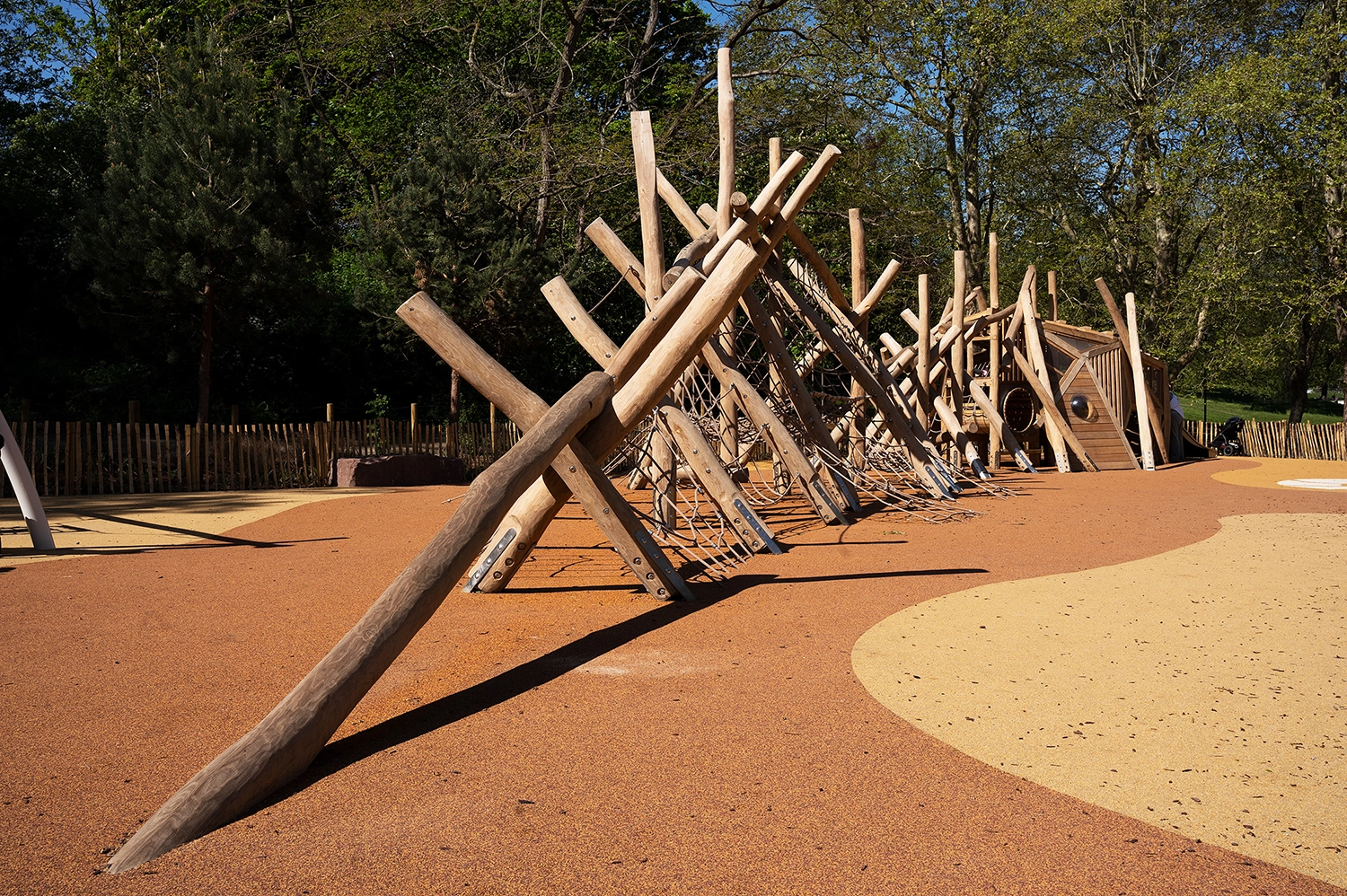
The playground as part of the public realm
Landscape architects have always been responsible for creating places where people want to spend time. They shape movement, planting, topography, materials, ecology and atmosphere to create landscapes that feel instinctively comfortable.
In our opinion, play deserves to be considered with exactly the same level of importance.
The most successful play environments don’t interrupt the landscape; they belong to it. They respond to the site’s history, character and topography, creating places that feel as though they could only exist in that location.
Increasingly, our early design conversations aren’t about swings or climbing frames. They’re about desire lines, biodiversity, drainage, shade, planting, seating, lighting and long-term maintenance.
That’s because play is no longer an isolated destination within a park. It’s becoming an integral part of the wider placemaking conversation.
Designing for everyone
One of the most important users of any playground is often someone who never climbs, swings or slides.
Parents need somewhere comfortable to stay. Grandparents need somewhere accessible to sit. Teenagers need somewhere they don’t feel they’ve outgrown, while friends and neighbours simply need somewhere to meet.
If those people don’t feel welcome, they leave. When they leave, the quality of the place changes with them.
We’ve been fortunate enough to revisit many of the playgrounds we’ve designed over the years. What has always fascinated us isn’t simply how children use the equipment, but how entire communities gather around it.
The most successful projects become social spaces first and playgrounds second.
Sometimes a well-positioned bench beneath a mature tree contributes more to the success of a place than another piece of equipment ever could.
Beyond the catalogue
There will always be a place for beautifully designed products. They remain fundamental to creating successful play environments.
But products should support a design vision rather than define it.
The best projects begin with completely different questions.
Who uses this place?
How do people move through it?
What makes this site unique?
How should people feel when they leave?
How can play reveal those qualities rather than compete with them?
When design starts with these questions, products become tools rather than objectives.
Looking ahead
As towns and cities continue to grow, public space will become increasingly valuable.
The places we create today will need to do far more than entertain children. They will need to support healthier lifestyles, strengthen communities, improve biodiversity, encourage social interaction and provide moments of calm within increasingly busy urban environments.
Play has a unique ability to contribute to every one of those ambitions.
But only if we stop thinking about playgrounds as collections of equipment and begin thinking about them as places.
That shift has fundamentally changed the way we approach every project at PlayEquip.
Our role isn’t simply to design or manufacture playground equipment. It’s to help architects, landscape architects and developers integrate meaningful play into the wider public realm, ensuring that play becomes part of the design conversation from the very beginning.
Because perhaps playgrounds haven’t simply evolved.
Perhaps we’ve finally realised they were never just playgrounds at all.


 (+44) 0177 383 0069