I’ve never been completely convinced by pirate ships. Not actual pirate ships. Playground ones.
We’re quite regularly asked to design playgrounds around a theme, particularly for schools, and I completely understand why. It’s an easy concept for everyone involved to visualise. But I’ve always wondered whether by telling children exactly what something is, we’re taking away part of what makes play interesting in the first place. St Paul’s Cathedral School is a good example. The original request was essentially, “Can we have a pirate ship?” Through the design process we gradually moved away from that and created something much more ambiguous. It still has a strong form and plenty of character, but it doesn’t tell the children what it is or, more importantly, how they’re supposed to play with it.
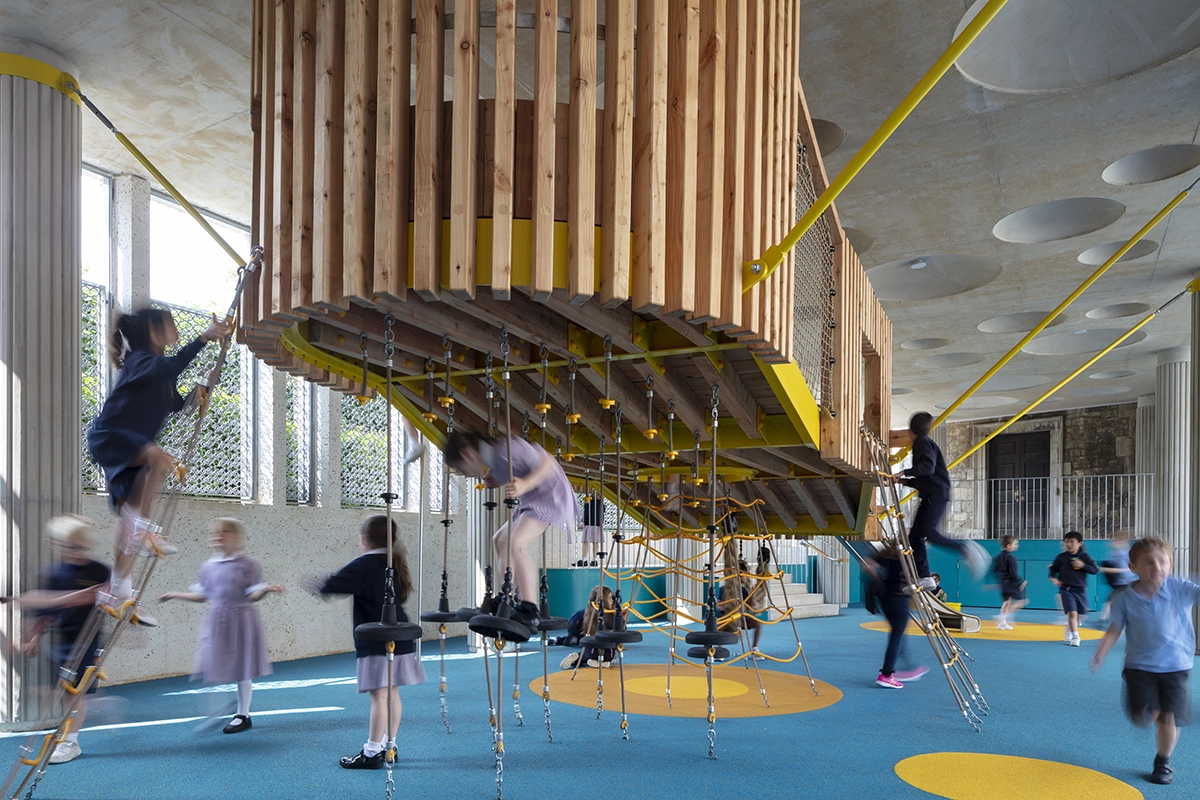
Over the years I’ve realised that children create games that are completely specific to the structures they’re given. A route becomes a circuit where nobody is allowed to touch the ground. A slide and fire pole become a race. A ball gets rolled down a ramp with the aim of getting it through a particular gap. None of these things necessarily appeared in the design brief, but children find them. I think good play structures need to allow for that. We obviously design routes, challenges and play opportunities into them, but there should also be enough ambiguity for children to discover things for themselves and create games that we never anticipated.
I’ve noticed something similar outside playgrounds too. At Yorkshire Sculpture Park I’ve always been fascinated by the difference between how adults and children look at sculpture. Adults tend to stand back and look. Children seem instinctively drawn towards it. They want to get close, touch it, move around it and, given the opportunity, climb onto it. Obviously the sculptures aren’t there to be climbed on, but I’ve always found that reaction interesting. There’s something about an unfamiliar three-dimensional form that seems to invite discovery. Perhaps that’s partly why I’ve always liked the idea of playground structures having something in common with sculpture. I love the idea of creating something with the presence and ambiguity of a piece of sculpture, but designed specifically so that children can climb on it, touch it and discover what it does.
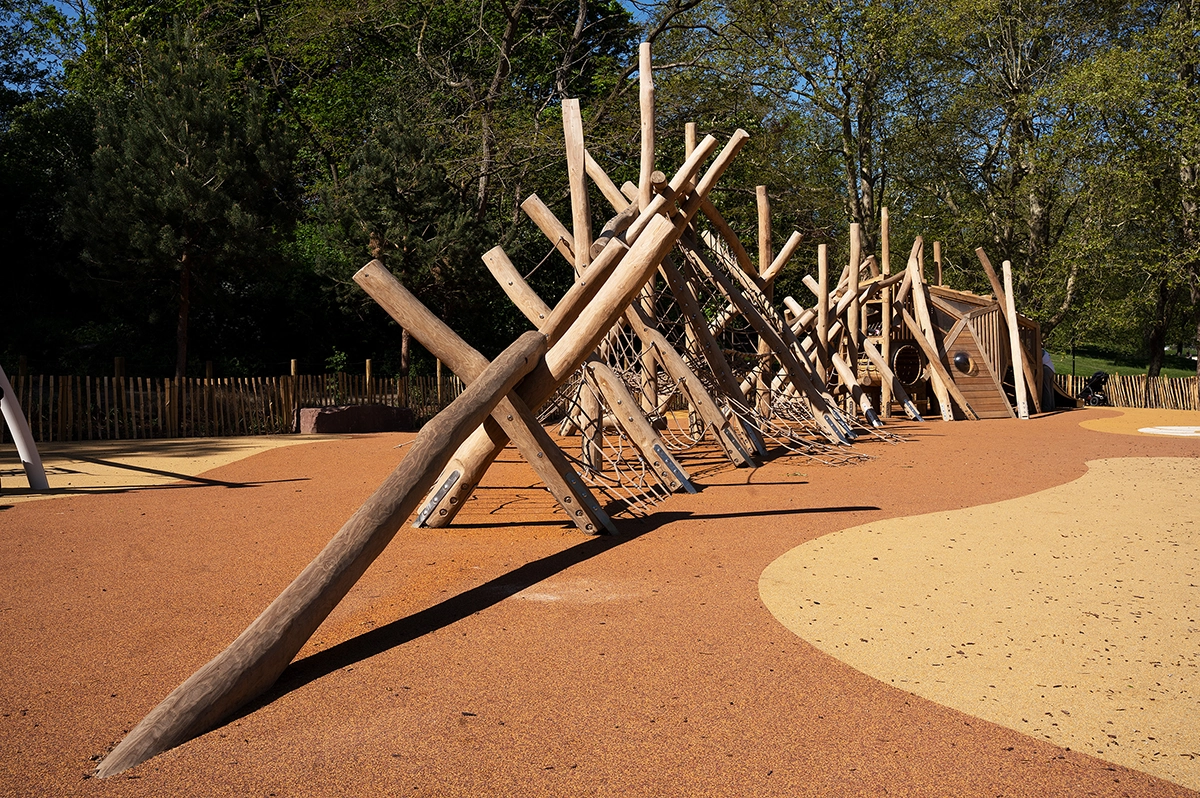
This isn’t to say that themes don’t have a place. Crystal Palace is probably one of the most themed playgrounds we’ve worked on, but the theme belongs to the place. We worked closely with HTA on the design of the dinosaur playground, developing a response that drew on the extraordinary history of the Crystal Palace dinosaurs without becoming too literal. Even then, we didn’t want to build a big green dinosaur. The skeletal forms and spines are deliberately contemporary and abstract. We did something similar working closely with Grant Associates at Queen’s Gardens in Croydon. The main structure takes some of its form from the crocus and its connection to the name Croydon, developing that idea into something much more abstract. Unless somebody told you where the influence came from, though, I’m not sure you’d necessarily know. And that’s partly the point.
The same thinking also influences the products we design. Our Cantilever Play Frame, for example, isn’t intended to represent anything in particular. It’s deliberately an unusual form, with different levels, routes and spaces that can be interpreted and used in different ways. We design the play opportunities into it, but try not to prescribe what the structure itself is supposed to be. For me, that’s an important distinction. Whether we’re working with a landscape architect on a large bespoke project or developing one of our own products, the principle is much the same. We can design how something is built, where the routes go and what physical challenges it offers, but we don’t necessarily need to design the game. That’s the part children are usually much better at.
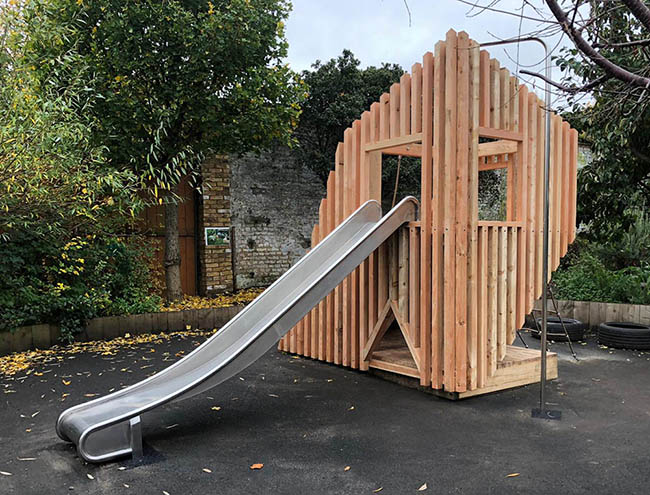
One of the first times I really understood this was years ago when I was building adventure playgrounds with Apes At Play. At Railton Road in Brixton we were constructing a playground designed by Root And Erect Architecture. The structure drew on the area’s history and had the appearance of a fragmented or dilapidated house. One day a man wandered onto the site, looked at what we’d built and announced that it was quite clearly a giant scorpion. It wasn’t. But I took another look and suddenly I could see exactly what he was seeing. I’ve always remembered that moment.
I think children do this far more naturally than adults. What looks like a climbing structure to us might be a ship, a house, a mountain, a den or something completely different to them. Tomorrow it might be something else entirely. It follows on from something I wrote about recently: children rarely use playgrounds in exactly the way adults expect them to. So perhaps we shouldn’t always be telling them what they’re supposed to imagine either.

 (+44) 0177 383 0069