
I’ve become slightly obsessed with planting in playgrounds. In my opinion, it’s something I don’t think our industry has historically given enough attention to. I obviously spend most of my time thinking and talking about equipment, surfacing, fall heights and play value etc., but historically considerably less time thinking about the vegetation that all of it sits within. The more we’ve worked alongside landscape architects and planting specialists, the more I’ve realised how much difference good planting can make. Not just aesthetically, but to how a playground actually feels and functions.
Most of our work is in cities, where playgrounds can quite easily become a collection of equipment surrounded by a large area of rubber safety surfacing. It works in some locations, but it can also feel quite hard and exposed if there’s too much. Good planting, like landscaping, immediately changes that. It brings softness, shade and nature into the space. On a hot day, like we seem to have more of, it can make a playground considerably cooler and, in a very urban location, it can turn what could otherwise be quite a hostile environment into a little oasis of something much greener and calmer. A contrast that obviously has its benefits. If you look at most skate parks on a hot summer’s day, you can see the opposite. They’re often almost entirely concrete, with zero shade, and can become incredibly hot and quite hostile places to be. These spaces and playgrounds don’t have to be like that.
We’ve therefore become much more interested in how planting can actually form part of the play space. The more we’ve done it, the more we’ve learnt that there is quite a lot of technical knowledge involved. We’ve had the rare experience of bringing the right professions together. We regularly find ourselves having conversations between landscape architects, planting specialists, arboriculturists and play safety inspectors. Each understands a slightly different part of the problem and between them you can often do considerably more than you might initially assume.

There are obvious examples, of course. You’re probably not going to put a rose bush underneath a climbing frame, but soft grasses and suitable herbaceous planting can potentially sit within fall zones of lower equipment like trim trails, where children might fall, because they don’t introduce the same hard or sharp obstacles. Trees are more interesting again. Depending on their position, height, form and the equipment around them, there are situations where trees can be incorporated into or around fall zones, with the relationship considered carefully with the play safety inspector. Rather than automatically removing planting from around equipment in the design, we’ve learnt to safely position equipment around it and understand what types of planting can work in different areas.
There are also the slightly less glamorous things you learn through experience. Bird poo. Trees above playground equipment are brilliant for shade, but birds inevitably come with trees, so we now think quite carefully about what we’re putting underneath them. Ropes and nets work particularly well because there’s very little horizontal surface for anything to land on. Enclosed tube slides can also be a good option because the actual sliding surface is protected. Climbing routes generally make much more sense beneath trees than equipment where children are going to sit for any length of time. We’d be more cautious about things like swing seats, open slides or platforms directly beneath a favourite bird perch. It sounds like a tiny detail, but these are the sorts of things you start to notice after designing and maintaining playgrounds for long enough.
Trees themselves are also something I think playground design has historically overlooked. Trees are perhaps the original climbing frame, but for a lot of children growing up in cities the opportunity to actually climb a tree is becoming increasingly rare. Where we have good existing trees on a site, we’ve often tried to work with them rather than treating them as something the playground has to keep away from. Sometimes that means building decking around a tree and allowing enough space for future growth. Sometimes it means allowing the tree to pass through a structure or making it part of the experience itself.
Our Elephant and Castle Treehouse structure is a good example of that. The existing tree was incredibly valuable and we needed to work out how best to incorporate it into the design. Working that closely with trees has also forced us to learn quite a lot about how you actually build around them. Root protection areas (RPAs) can look quite restrictive on a drawing, particularly when you’re trying to build a substantial play structure, but they don’t necessarily mean nothing can be built there. Again, working with the right professions, from arboriculturists and structural engineers, a balance can be achieved and something that seemed impossible suddenly becomes possible. They do mean that the foundations and the structure itself need to be considered much more carefully. The Elephant and Castle project was a shining example of that.
Working with arboriculturists and engineers, we’ve used screw piles, carefully hand-dug foundations and free-draining raft foundations to avoid or minimise interference with root systems. Screw piles can reduce the amount of excavation required compared with conventional concrete foundations, while hand digging allows larger roots to be identified as you go rather than simply excavating through them. Where a significant root is found, the foundation position can sometimes be moved and the structure above adapted to suit. Free-draining raft foundations can provide another solution in the right circumstances, spreading loads over a wider area while avoiding more intrusive excavation.
That adaptability in the structure itself is something we’ve learnt is really important. If you’re designing within a root protection area, having every post and foundation fixed to an exact position can create problems once you actually start digging. If the structure has some tolerance built into it, foundation positions can potentially be adjusted slightly to work around the root system that’s actually found on site. Post positions, connections and parts of the structure can then be adapted accordingly. It requires a different way of thinking about the design, but it means you can build some surprisingly substantial structures around valuable existing trees without simply assuming that nothing can be done.
I find that quite exciting because historically the alternative might simply have been to avoid the tree, but with the right technical input, quite often the tree and playground can work together.
Broadmarsh in Nottingham is probably one of the clearest examples we’ve worked on of planting completely changing the character of a playground. It’s an extremely urban city-centre location, but the play elements weave through substantial and well maintained planting rather than sitting separately from it. The timber, planting and landscape all start to become part of the same thing. It feels considerably softer than it would have done if the same equipment had simply been surrounded by rubber safety surfacing.

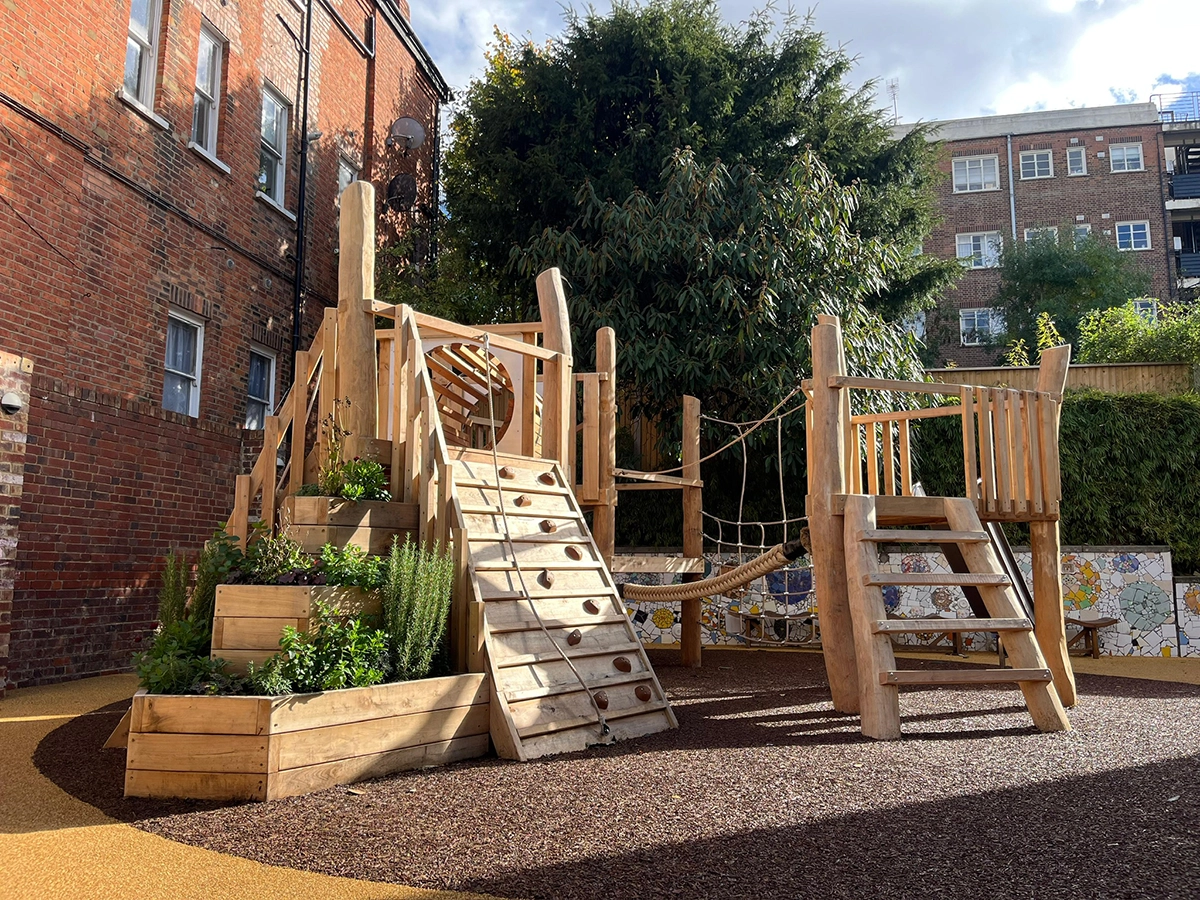
We’ve seen something similar recently at Kensington Girls School. Again, the planting isn’t really there as decoration around the playground. It’s a significant part of the design and has completely changed how the finished space feels. The timber structures sit amongst the planting and existing trees, and in some places we’ve built planters directly into the structures to encourage climbers to grow up and around them. Over time, these will provide additional shade in the summer and bring even more softness and greenery to what is otherwise a fairly constrained London school playground.
That’s probably where our thinking has changed most. We used to concentrate primarily on the play structures and then consider what happened around them. We’re now more interested in the relationship between the two. A tree might provide shade, but perhaps it can also become something the structure works around. Planting might soften a fall area rather than everything automatically becoming rubber. Grasses can create movement and texture around equipment.
I think that’s probably where our thinking has changed most. We’re increasingly bringing landscape architects, planting specialists, arboriculturists, engineers and play safety inspectors into the same conversation. Perhaps historically those conversations haven’t always happened when playgrounds were being designed. We’ve learnt an enormous amount from that overlap, and with every project we’re getting a better understanding of how planting, existing trees and play structures can work together.
Rather than designing a playground and then landscaping around it, or vice versa, increasingly we’re trying to design the two together.

 (+44) 0177 383 0069


